Move path points.
Refine a vector outline without redrawing it.
Try it in your agent.
Use this prompt as a starting point. Review the result, then ask for the details you want to change.
A prompt to start from
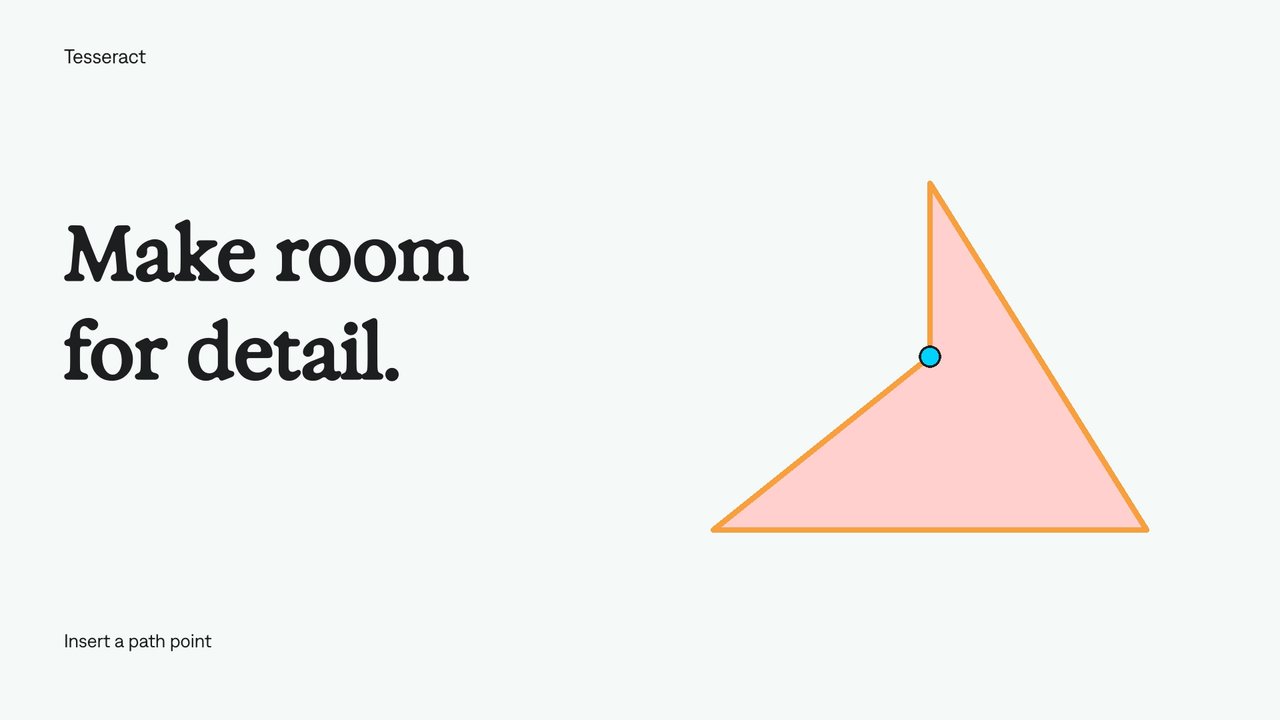
Use Tesseract. Create an eight-second silent Tesseract vector-edit study. Set “Small move. / New shape.” at left on Bone. At right, use one editable Sea quadrilateral. Move only its top-left path anchor 150 px right and 90 px up; every other anchor stays fixed. A small high-contrast marker follows that selected anchor exactly. Animate the actual path coordinates, then hold the altered outline. Keep independent before and after project sources showing the one-anchor change; this is a canonical geometry edit, not a claim to have invoked a unavailable editor action.
New to Tesseract? Find the setup for your local agent.
A few useful details.
How do I try this with my agent?
Copy the prompt into your supported local agent with Tesseract installed. Review the preview, then ask for the changes you want. The composition stays editable as you refine it.
Where does the video render?
Tesseract previews and renders locally on macOS, Windows, or Linux. The local engine is free; your agent’s subscription or usage costs are separate.
Try these next.
Your next video, made with your agent.
Install Tesseract in your local agent, bring a brief, and start creating.
Free on Mac, Windows, and Linux. Your agent’s costs are separate.
Read the prompt
Set up Tesseract by Mirage so you can create editable designs, edit videos, and make motion graphics in this agent’s environment. Read https://github.com/mirage-hq/Tesseract and check the requirements for this local or hosted environment. If it is supported, follow the official plugin or skills installation guide, use its required runtime version, verify the download checksum, and confirm a short preview renders correctly. Then ask what I want to make and which brand references or source assets I have. Keep the editable project and source assets with the finished render.